
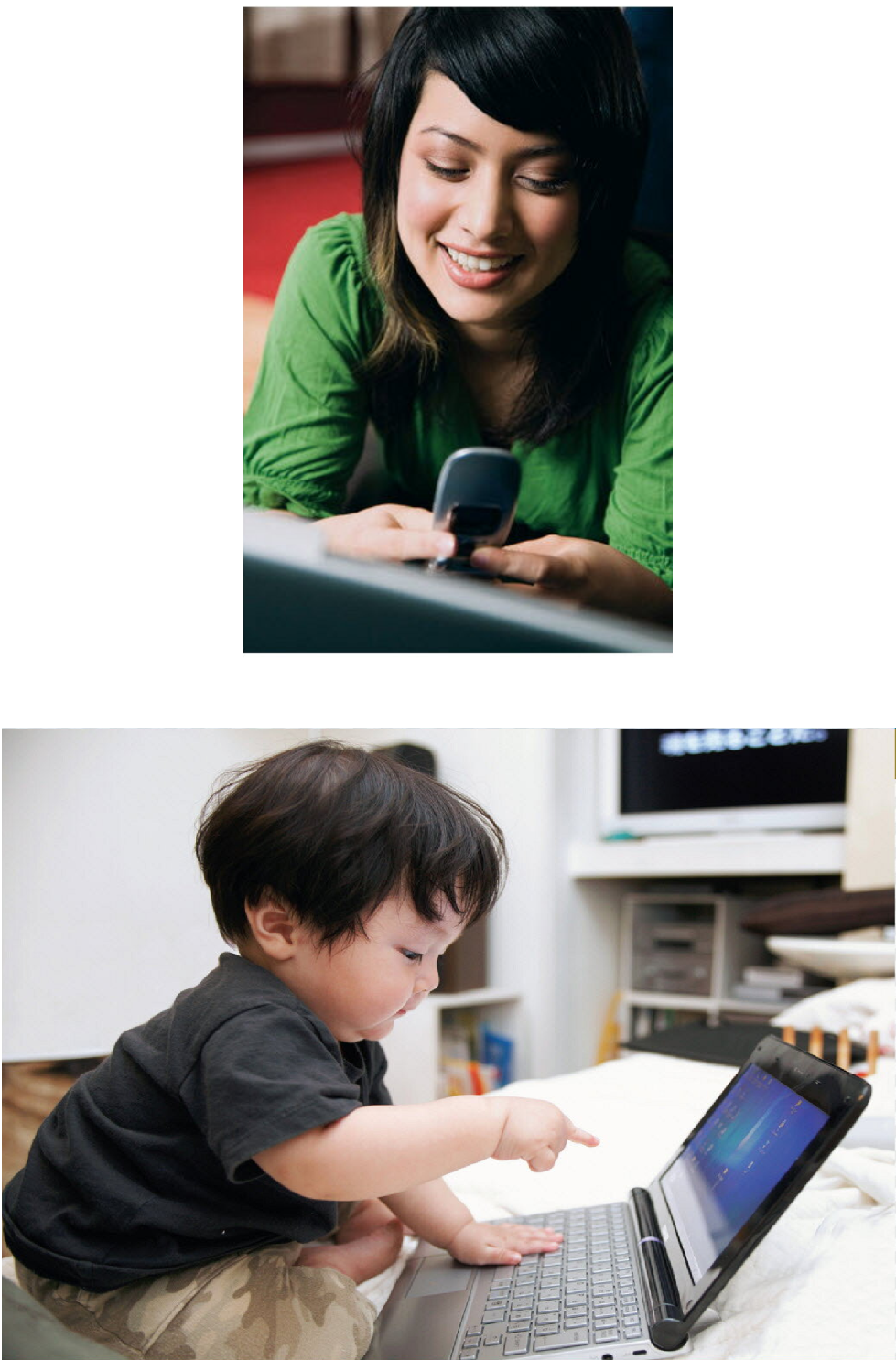
In Istanbul, Yesim Yilmaz is getting ready for class. Her mother brings her some breakfast, which Yesim eats while looking at her e-mail on her phone. She has forgotten to read a chapter for her biology class. No problem-she opens up her laptop and downloads a chapter from her online textbook to read on the train.
On Sunday afternoon next to his apartment complex¹ in Seoul, Min-ho Park is waiting for the bus. At lightning speed, he types a text message to let his friend know he’s on his way. Min-ho is never without his phone. In fact, he’s already bought a ticket on his phone for a movie he and his friends will see this afternoon. Min-ho laughs as he checks some funny photos his friend Jae-sung has just posted3 online. His bus soon arrives. Min-ho gets on, sits down, opens a game app4 on his phone, and puts his earphones in his ears. Most of the other people on the bus who are Min-ho’s age are doing exactly the same thing.
Yesim and Min-ho are members of Generation Z. They are sometimes called “digital natives” because they have grown up with the Internet, mobile phones, and social media5 since they were children. In fact, many have never seen a VCR or a telephone with a dial. Members of Gen-Z are people born between the mid-1990s and the early 2000s. They are also sometimes called Generation C, where the C stands for content, community, or creative.
Their parents spent most of their teenage years listening to cassette players, watching VHS tapes, playing early video games, and calling friends on their families’ telephones. Generation Z, however, is connected to its music, videos, games, and friends online all day, every day. Recent surveys show that young people in Asia spend an average of 9.5 hours per
day online. And marketing companies know this.
Every time they open their page on a social networking site, Gen-Z members don’t see only friends’ updatess and photos. They also see ads for products they might want to buy. Marketing companies work with social media sites to find out where their customers live, what movies, books, and music they like, and who their friends are. The companies use this information to show their customers the advertisements they want them to see.
What does this generation think about marketing companies knowing so much about them? Are they worried about losing their privacy? Not many seem to be very worried about companies knowing how to sell things to them. Many Gen-Z members are more concerned about keeping their private information from their parents. For example, Valerie Chen in Kaohsiung is upset because her parents want to watch everything she does online. But her parents’ eyes are not enough to make her stop using social media. Valerie knows how to limit what her parents can see about her on the social networking sites she uses.
However, keeping information private from parents may not be the only challenge. Many people are now finding out that posting funny
pictures on the Web can be a problem when they finish school and start looking for a job. In fact, some studies show that more than 70% of companies reject people who are looking for jobs because of what they can see about them online. Because they grew up using social media, maybe Generation Z will be better at protecting their personal information online than the generation before them. Only time will tell.